

ESTATE JOURNAL
The Private Infrastructure Behind Orange County’s Most Effortless Homes

By Elle Flannery | Coastal Peace of Mind The systems, standards and quiet coordination that allow an exceptional home to feel entirely effortless.
ou may never see the estate calendar,

the property records or the careful coordination taking place behind the scenes. You simply arrive to a home that is prepared, protected and operating exactly as it should. That sense of ease is not spontaneous. It is the result of disciplined systems and one trusted professional quietly accountable for the whole.
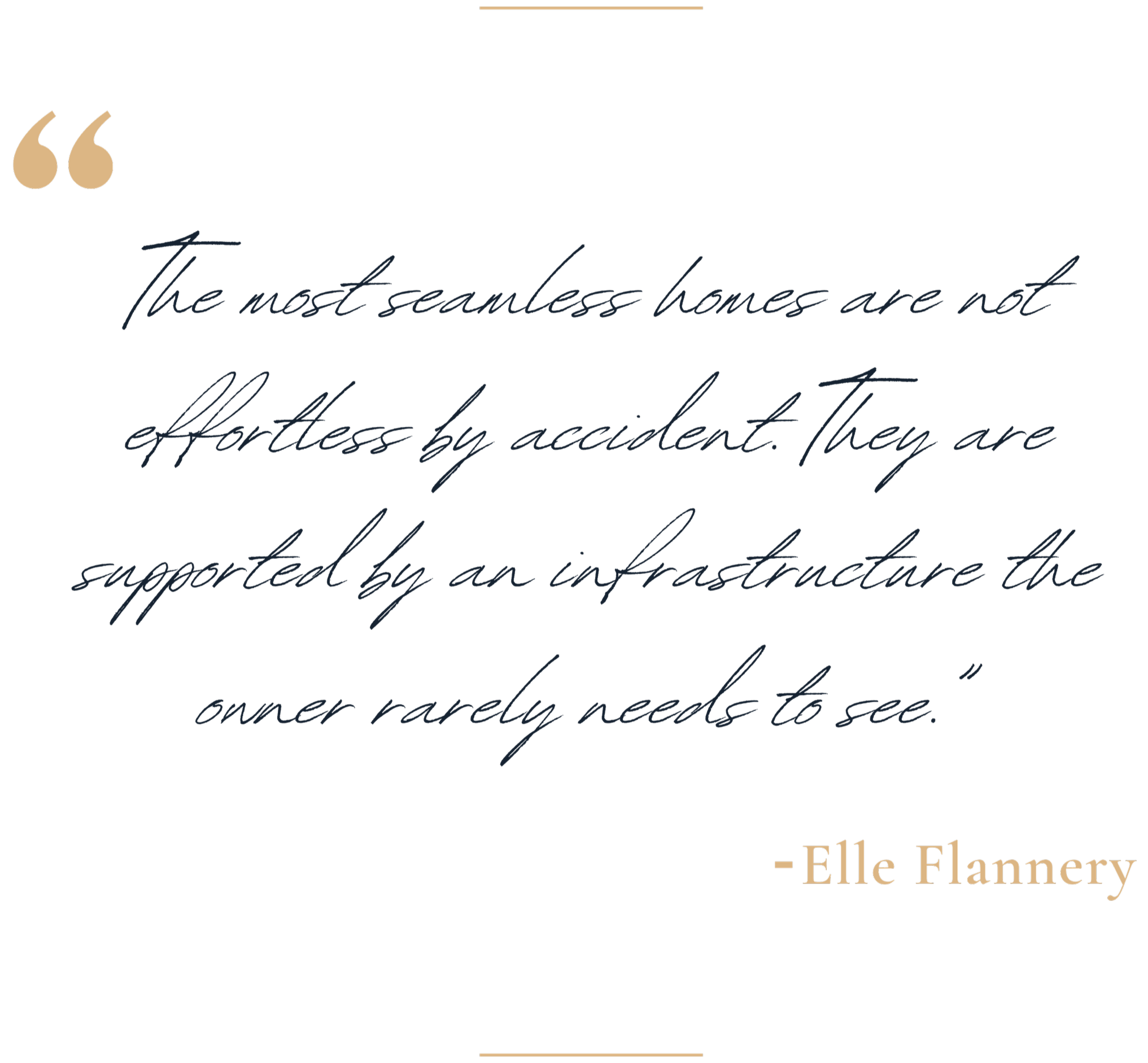
The finest homes do not run on good intentions. They run on systems, standards and someone quietly accountable for the whole.
Some homes seem to operate without effort. The doors open. The temperature is perfect. The terrace is prepared, the car is ready and the refrigerator contains precisely what everyone hoped it would. Guests arrive to fresh rooms, outdoor spaces are immaculate and no one is discussing the water filtration system over dinner. It can all appear wonderfully spontaneous. It is not.
Behind the most seamless private residences is an invisible operational structure: carefully maintained records, preventative schedules, trusted staff, supervised vendors and clear authority when something requires attention. The homeowner may rarely see this infrastructure. That is usually how they know it is working.
Effortless Living Requires Considerable Effort
Orange County is home to residences of extraordinary luxury and complexity. Beyond the architecture and interiors, there may be integrated lighting, security, climate control, specialty refrigeration, extensive landscaping, custom stone and mechanical systems that require their own small education.
Then there are the people. Housekeepers, landscapers, pool technicians, contractors, personal assistants and private chefs may all move through the property. Add vehicles, pets, guests, a yacht or another residence and the home begins to resemble a private organization without the benefit of an operations department.
Many homeowners attempt to manage this through a combination of text messages, familiar vendors and information stored somewhere in an inbox. It works until it doesn’t. A service is missed. A warranty cannot be located. A staff member leaves and takes years of household knowledge with them. Three people have access to the property but no one can confirm who entered on Tuesday. The home may still look beautiful. Operationally, it is being held together by the owner’s memory.
The Estate Calendar: Where Prevention Begins
A professionally managed residence should have a detailed estate calendar that tracks recurring preventative care and seasonal maintenance throughout the year. HVAC servicing, roof and drainage inspections, generator testing, irrigation reviews, pest control, exterior cleaning, stone sealing and specialty appliance maintenance should be scheduled before they become urgent. Nothing should depend on the homeowner remembering that the water filtration system is due for service or wondering whether the exterior hardware was inspected before another season of coastal exposure.
The calendar should also record what was completed, who performed the work and what follow-up was recommended. This turns maintenance into a managed process rather than a recurring surprise. The objective is not to create a home that never experiences a problem. Homes remain homes and occasionally display a flair for inconvenient timing. The objective is to make sure small issues are identified while they are still small.
The Home Needs an Operational Memory
Exceptional residences accumulate an enormous amount of information. There are warranties, finish specifications, paint formulas, appliance records, service histories, gate instructions and preferred vendor details. There may be notes about which product is safe for the limestone, which contractor fabricated the custom cabinetry and which technician understands the lighting system well enough not to reset the entire house. That information should not exist only in one employee’s memory or across years of text messages.
A private estate needs a centralized property record. It should preserve the history of the home, document decisions and allow a qualified professional to understand what has been done before recommending what should happen next. This becomes especially important when staff changes or a new vendor is introduced. Without documented continuity, the residence is forced to begin again every time someone leaves.
A well-run home should not develop institutional amnesia.
Excellent People Still Need Leadership
A household may employ exceptionally capable people and still operate inconsistently. The housekeeper may have her own system. The assistant may manage a separate calendar. The gardener communicates with the owner and the handyman communicates with everyone except the person expecting him. Individually, each person may be doing good work. Collectively, the household is improvising.
Private infrastructure gives the team clear responsibilities, communication standards and one informed point of leadership. Staff understand what is expected, which decisions they may make and how concerns should be escalated. They also understand the standard of care required by the residence.
That means knowing how to protect natural stone, custom millwork and delicate finishes. It means avoiding scuffed baseboards, checking switch plates to ensure that no fingerprints are left and ensuring that a room is not merely clean but properly reset. These details are not about perfection for its own sake. They protect the home from the quiet accumulation of careless wear.
Vendor Access Is Not Vendor Oversight
A trusted vendor list is useful. It is not an operating system. Vendors must be selected carefully, given a clearly defined scope and supervised according to the level of risk involved. Their work should be closely overseen, verified before any invoice is approved and followed by a thorough inspection of the property once they leave.
Inside a finely finished residence, protective measures should be established before the first toolbox enters. Booties, floor coverings and protected work routes are not excessive. They are basic precautions when one accidental scrape can damage custom flooring or one unsuitable cleaner can permanently alter natural stone.
Exterior areas deserve the same attention. A vehicle leaking oil onto a porous cobblestone driveway can create damage that may not be fully removable. By the time the stain is discovered, replacement may be the only way to restore the surface properly.
A true estate manager does not wait to see whether the vendor understands this. They establish the standard before the vehicle arrives. The repair should resolve the original issue, not introduce a new one on the way out.
Financial Oversight Should Bring Clarity
Private homes generate a steady stream of estimates, invoices, recurring services and project expenses. Without structure, the homeowner receives a collection of documents but very little useful financial oversight.
A well-managed estate establishes approval thresholds, reviews invoices against completed work and identifies unusual charges before they become routine. Estimates are compared thoughtfully and recommendations are presented with context. The owner should understand what is being spent, why it is necessary and whether the work represents long-term value.
This does not mean selecting the lowest bid.
In exceptional homes, the least expensive option can become remarkably costly once it damages a finish, requires repeated corrections or fails prematurely. The goal is informed stewardship. Premium materials and complex systems deserve decisions based on judgment rather than whichever proposal arrived first.
Access and Security Require Deliberate Control
Over time, private homes can accumulate a surprising number of keys, gate codes and alarm permissions. Housekeepers, vendors, contractors, assistants and former employees may all have had access at some point. Without a formal process, no one is entirely certain who still does. Access should be intentional, limited and documented.
The estate manager should know who is entering the residence, when they are expected and why they are there. Temporary access should expire. Staff changes should trigger an immediate review of credentials and the property should be secured after every service visit. This is not about creating distrust. It is about protecting privacy through structure. A homeowner should never have to wonder whether an old contractor still has the gate code because no one remembered to change it.
Arrival and Departure Are Operational Events
The arrival experience is one of the clearest demonstrations of private infrastructure. Before the owner returns, the residence should be inspected, cleaned and brought to the preferred temperature. Lighting, water, refrigeration, technology and security should be tested. Outdoor spaces should be prepared and provisions arranged. Vehicles may need attention. Guest rooms may need to be opened and reset. Household schedules may need to change and any unresolved issue should be communicated before the owner walks through the door.
Departure requires its own process. The home must be secured, perishables addressed, systems adjusted and staff informed. Access schedules may need to change and upcoming services should be reviewed against the owner’s absence.
A beautifully managed residence does not simply open and close. It transitions. That is why the owner can arrive and feel as though the home has been waiting for them rather than waiting on them.
Emergency Readiness Should Exist Before the Emergency
A private residence should have clear protocols for leaks, power failures, security concerns, storms and wildfire conditions. The estate manager should know where shutoffs are located, which systems they affect and what can be authorized without waiting for the owner. Insurance details, alarm information, emergency vendors and property-specific instructions should be readily accessible. If the residence includes pets, generators, elevators or specialized equipment, those considerations must be included as well.
The plan should also account for the owner being unavailable.
A crisis is not the moment to discover that the only person authorized to approve a repair is asleep in another time zone. Preparedness allows the first response to be calm, informed and proportionate. It also prevents a manageable issue from becoming a larger one while everyone waits for direction.
The Infrastructure Extends Beyond the House
For many homeowners, the residence is only one part of a broader private ecosystem. There may be vehicles that require servicing, a yacht that must be prepared, pets with appointments, household staff to manage and several properties operating at once.
Handled separately, these responsibilities create a constant stream of small decisions. Handled through one trusted point of continuity, they become part of a coherent private operation.
The value is not simply convenience. It is the ability to see how one decision affects the whole. A guest arrival may influence staffing, transportation, provisions and vessel preparation. A household project may affect security, cleaning schedules and the use of certain rooms. Someone must understand the wider picture. Otherwise the homeowner becomes the only person connecting it.
The Owner Should Not Be the Infrastructure
Many exceptional homes appear effortless because the owner is quietly doing an extraordinary amount of work behind the scenes. They remember the maintenance schedule. They connect the vendors. They direct the staff and hold the history of the property in their head. The residence functions because they remain mentally attached to it.
That is not effortless living.
It is unpaid estate management.
The purpose of professional private infrastructure is to remove that operational weight. The owner should not need to chase updates, interpret vague reports or coordinate several people who are all technically helping. They should receive clarity, thoughtful recommendations and the confidence that someone qualified is already paying attention.
True Luxury Is Continuity
The most refined homes are not defined only by what they contain. They are defined by how they operate. The materials are cared for correctly. The staff understand the standard. The vendors are accountable, the records are complete and the next season’s maintenance has already been scheduled.
The owner arrives to a residence that feels calm because the work behind it has been organized with precision. That is the private infrastructure behind Orange County’s most effortless homes. It is not intended to be seen. It is intended to make everything else feel beautifully under control.
The Estate Journal
Continue Reading
NEXT IN THE ESTATE JOURNAL

PREVIOUS IN THE ESTATE JOURNAL


Exceptional homes deserve exceptional stewardship.
If you'd like to explore how private estate management can simplify ownership while protecting your investment, we'd be pleased to arrange a confidential consultation.