

ESTATE JOURNAL
Why Luxury Homeowners Are Still Managing Their Property Managers
The quiet gap between property management and true estate oversight.

By Elle Flannery | Coastal Peace of Mind The bills get paid. The vendors show up. The reporting arrives in your inbox. And yet, you still find yourself chasing follow-ups, making decisions and holding the whole system together.
You’re not alone.
ou’ve hired a property manager.

The house is professionally managed. So why is the owner still approving invoices, chasing vendors and wondering who moved the pool furniture?
There is a particular irony in luxury homeownership: the more support a homeowner hires, the more people they can end up managing.
There is the property manager who coordinates repairs. The housekeeper who notices problems first. The contractor who communicates through three separate text threads. The landscaper who arrives on a different day each week and the pool technician who insists the water has always looked that way.
Then there is the homeowner, usually from an airport lounge or the back seat of a car, trying to determine whether the leak is urgent, whether the invoice is reasonable and whether anyone remembered to prepare the guest suite.
This is not exactly the carefree coastal lifestyle they had in mind. The issue is rarely that nothing is being done. The issue is that no one is truly overseeing the whole.
Coordination Is Not the Same as Management
Traditional property management is often built around transactions: receive the request, contact the vendor and confirm the work was completed. That structure can be perfectly adequate for a rental property or a relatively straightforward residence.
A private estate is neither.
Luxury homes are living systems. They include specialty finishes, complex mechanical equipment, valuable furnishings, household staff and service providers who must work around the owner’s schedule and one another. Add a second residence, a remodel, a yacht or a household pet with more appointments than most executives and the operation becomes considerably more involved.
The work is not merely arranging for someone to fix what broke. It is knowing what is likely to break next, who should handle it and whether the proposed repair makes sense in the context of the entire property. A homeowner should not need to explain the residence from the beginning every time a new issue arises.
The Homeowner Becomes the Missing Middle
Many affluent homeowners find themselves acting as the bridge between everyone involved in their home. They are forwarding estimates between vendors. They are reminding staff that guests are arriving Friday. They are checking whether the air conditioning was serviced before summer. They are asking why the electrician replaced a fixture without consulting the designer and why no one mentioned that the wine refrigerator had stopped cooling.
Individually, these may seem like small tasks. Collectively, they become another job. The frustration is not always dramatic. More often, it is a steady stream of decisions that should never have reached the homeowner in the first place.
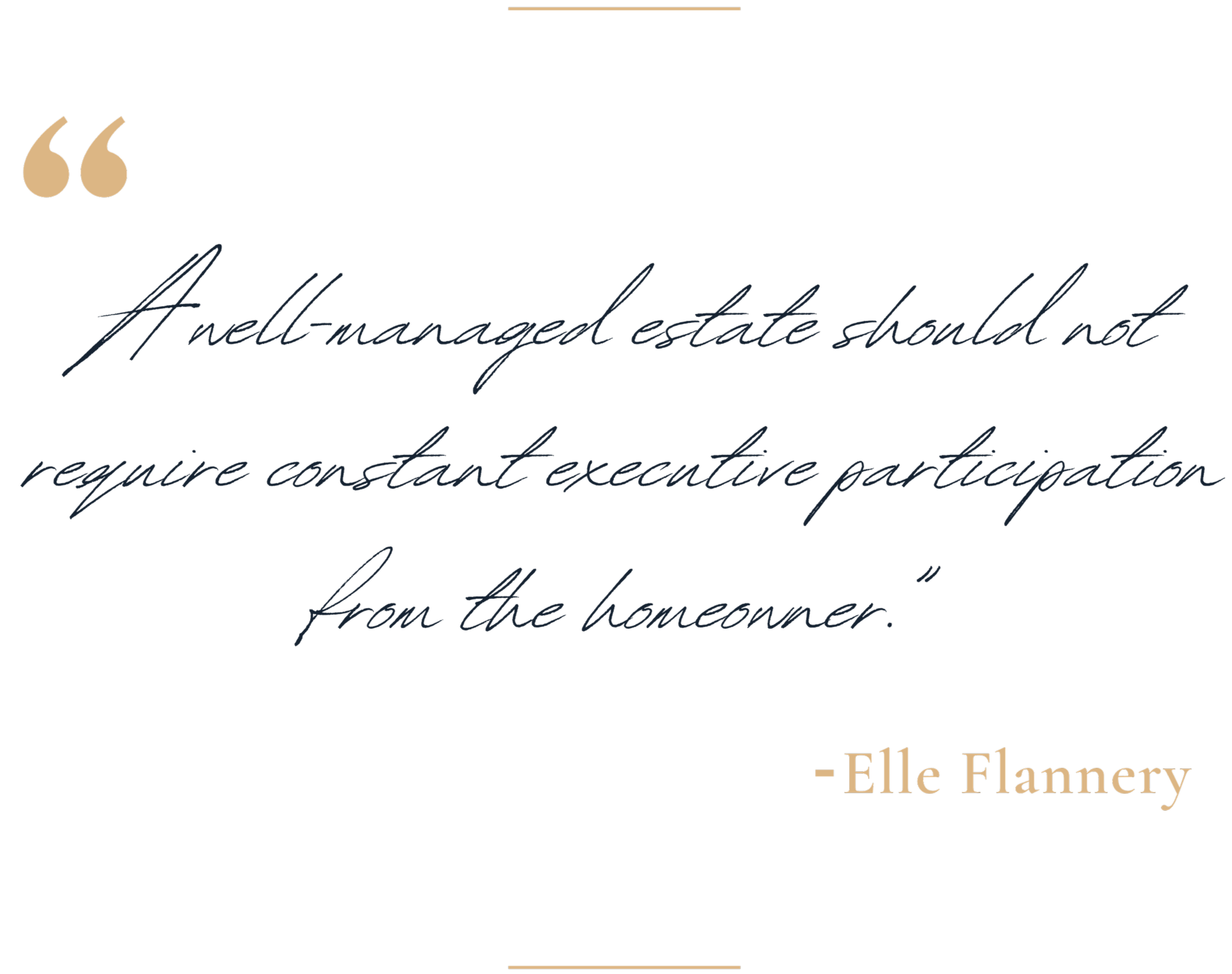
A well-managed estate should not require constant executive participation from the person paying to have it managed.
What an Estate Manager Actually Does
A skilled estate manager creates continuity. They understand how the property functions, how the household prefers to communicate and which details matter to the owner. They oversee vendors, track maintenance and notice patterns before they become problems. They prepare the home for arrivals and secure it after departures. They manage household staff, document decisions and ensure that projects do not quietly drift beyond their scope.
Most importantly, they reduce the number of questions that reach the homeowner. This does not mean making decisions without authority. It means presenting the right decision at the right time with the necessary context.
Instead of:
“The HVAC company says something is wrong. What do you want to do?”
The homeowner receives:
“The upstairs unit is showing early compressor failure. I obtained two assessments, reviewed the warranty and recommend repair rather than replacement. The work can be completed Thursday before your arrival.”
That is the difference between relaying information and managing an estate.
Luxury Is Often Operational
Luxury is usually described through materials and experiences: stone sourced from Italy, hand-finished cabinetry and ocean views that make dinner reservations feel unnecessary. Yet the most meaningful form of luxury may be far less visible.
It is arriving to a home that is already comfortable. It is opening the refrigerator and finding exactly what was requested. It is knowing the vehicle has been serviced, the terrace has been prepared and the guest room does not contain a surprise plumbing issue. It is also the confidence that someone capable is paying attention while the owner is away.
The best estate management is rarely theatrical. It is quiet, anticipatory and almost invisible. Problems are handled before they become stories. Staff know what is expected. Vendors are supervised and the homeowner is not copied on an email chain involving grout samples.
That is not indulgence. It is competent stewardship.
The Real Standard
Luxury homeowners do not need more people sending them updates. They need one trusted person who understands which updates matter. The true measure of estate management is not how busy the manager appears or how many vendors are on speed dial. It is how little operational weight remains on the homeowner’s shoulders.
A beautifully managed home should feel effortless, even though the work behind it is anything but. And perhaps that is the simplest test: if the homeowner is still managing the property manager, the property is not fully managed yet.
The Estate Journal
Continue Reading
NEXT IN THE ESTATE JOURNAL

PREVIOUS IN THE ESTATE JOURNAL


You should direct the vision, not manage every detail.
We come to know your residence with the depth and familiarity required to protect it properly—its systems, rhythms, standards and your personal preferences—so the daily oversight, vendor coordination and follow-through no longer rest with you.