

ESTATE JOURNAL
The Hidden Cost of Reactive Care for a Coastal Residence

Why waiting until something breaks is the most expensive way to care for a coastal home.
By Elle Flannery | Coastal Peace of Mind ou can have the finest finishes,

the most trusted vendors and a view worth protecting. But without someone consistently watching the property between service calls, small vulnerabilities begin making expensive plans of their own. Salt air does not send a reminder. Moisture does not wait for a convenient weekend and a minor issue left unattended has a remarkable talent for becoming a major one just before you arrive.
By the time a coastal home makes its problem obvious, it has usually been quietly rehearsing for months. Coastal homes are very good at looking unbothered. The view is calm. The stone is immaculate. The doors glide open to the ocean and everything suggests that life here should require little more than remembering where the chilled rosé is kept.
Meanwhile, salt air is working on the metal. Moisture is testing the seals. Irrigation is drifting toward the foundation and one temperamental drain is waiting for the exact weekend the house is full of guests. This is the trouble with reactive care: it begins after the residence has already decided how expensive the problem is going to be.
Coastal Homes Do Not Fail Politely
Most household problems do not arrive with a formal introduction. A small roof vulnerability becomes interior staining. A slow plumbing leak becomes damaged cabinetry. A corroded exterior fixture fails. A neglected drain backs up during heavy rain. An air-conditioning system that sounded “a little different” stops working two hours before the owners arrive.
By the time the problem is visible, the simple repair may no longer be simple.
Coastal properties are particularly unforgiving because their materials and systems live under constant environmental pressure. Salt, wind, sun and humidity do not need to create a dramatic event. They simply need time. This is why a home can appear beautifully maintained while its smaller vulnerabilities continue to accumulate out of sight. The polished stone may be pristine. The mechanical room may be telling a different story.
Reactive Care Is More Expensive Than the Invoice Suggests
When something breaks, the repair bill is only the beginning. There may be emergency callout fees, expedited materials and secondary damage. There may be disrupted travel plans, cancelled guests or hours spent coordinating access from another city. There may also be the uncomfortable discovery that no one knows when the system was last serviced, whether the product is under warranty or which vendor completed the original work.
Then the homeowner becomes the project manager. They are reviewing photographs, comparing estimates and asking several people for slightly different versions of what happened. Their property manager may be forwarding messages from the contractor. The contractor may be waiting for the plumber. The plumber may be waiting for access.
Everyone is technically involved. No one is holding the full picture. This is how a leak becomes a group chat.
The Most Expensive Problems Are Often the Quietest
A coastal residence does not always announce neglect through a burst pipe or a flooded room. Some of the costliest issues develop gradually. A seal begins to fail. A retaining surface shows early movement. Exterior hardware starts to corrode beneath its finish. An irrigation line creates repeated moisture near the structure. A specialty appliance operates just well enough to avoid attention until replacement parts are months away. None of these issues feels urgent on an ordinary Tuesday. That is precisely why they are dangerous.
Without consistent oversight, a home is often maintained according to what is visible, what is scheduled and what has already gone wrong. Preventative estate care operates differently. It asks what has changed, what is approaching the end of its useful life and what deserves attention before the homeowner ever notices it. The goal is not to obsess over every hinge. It is to know which hinge is attached to a custom door that will take twelve weeks to replace.
Vendor Coordination Is Not Preventative Management
Calling a vendor after a problem occurs is useful. It is not the same as managing the residence. Preventative estate management requires continuity. Someone must know the home well enough to recognize that a stain is new, a sound is unusual or a service recommendation does not align with the property’s history.
That person should also know which vendors are reliable, which systems are under warranty and which repairs require approval before the scope quietly expands. A vendor sees the system they were hired to inspect. An estate manager sees how that system affects the home, the staff and the owner’s plans.
That distinction matters.
The pool technician may resolve the equipment issue. The estate manager also confirms that the surrounding surface is protected, the work is documented and the area is ready before guests arrive.
The HVAC company may recommend replacement. The estate manager reviews the service history, obtains another opinion and determines whether the urgency is mechanical or merely enthusiastic.
Deferred Decisions Compound
Luxury homeowners are often busy enough that non-urgent household decisions remain non-urgent for months. An estimate sits in an inbox. A minor repair is postponed until the next visit. A vendor suggests monitoring something but no one establishes who is monitoring it or how often.
Nothing happens.
Then several things happen at once.
This is where the cost of reactive care becomes less about one neglected task and more about accumulated operational drift. The residence begins to rely on memory rather than systems. Maintenance is handled by whoever notices the issue first. Records are scattered among emails, texts and invoices. Important decisions depend on the homeowner being available at exactly the wrong moment.
A professionally managed estate should not depend on the owner remembering what needs attention. That is rather the point of having it professionally managed.
A Beautiful Home Still Requires an Operating Strategy
The more sophisticated the residence, the less effective casual oversight becomes.
Specialty finishes require particular care. Integrated systems require coordinated servicing. Outdoor spaces need seasonal planning. Household staff need direction and vendors need supervision. Arrival preparation must happen before the arrival, which sounds obvious until someone is purchasing batteries at 9:30 p.m.
The home needs more than a maintenance calendar. It needs an operating strategy.
That includes routine inspections, documented service histories and clear approval thresholds. It includes seasonal planning, vendor accountability and follow-through. It also includes knowing what deserves immediate escalation and what can be resolved quietly without interrupting the owner’s day. The purpose is not to create more reports. It is to create fewer surprises.
Peace of Mind Is Built Before the Emergency
The strongest estate management is often invisible. The drainage is cleared before the storm. The mechanical system is serviced before the heat arrives. The corrosion is addressed before the component fails. The guest suite is inspected before anyone unpacks. The homeowner may never know how close a small issue came to becoming a large one.
That is not a lack of value. It is the value.
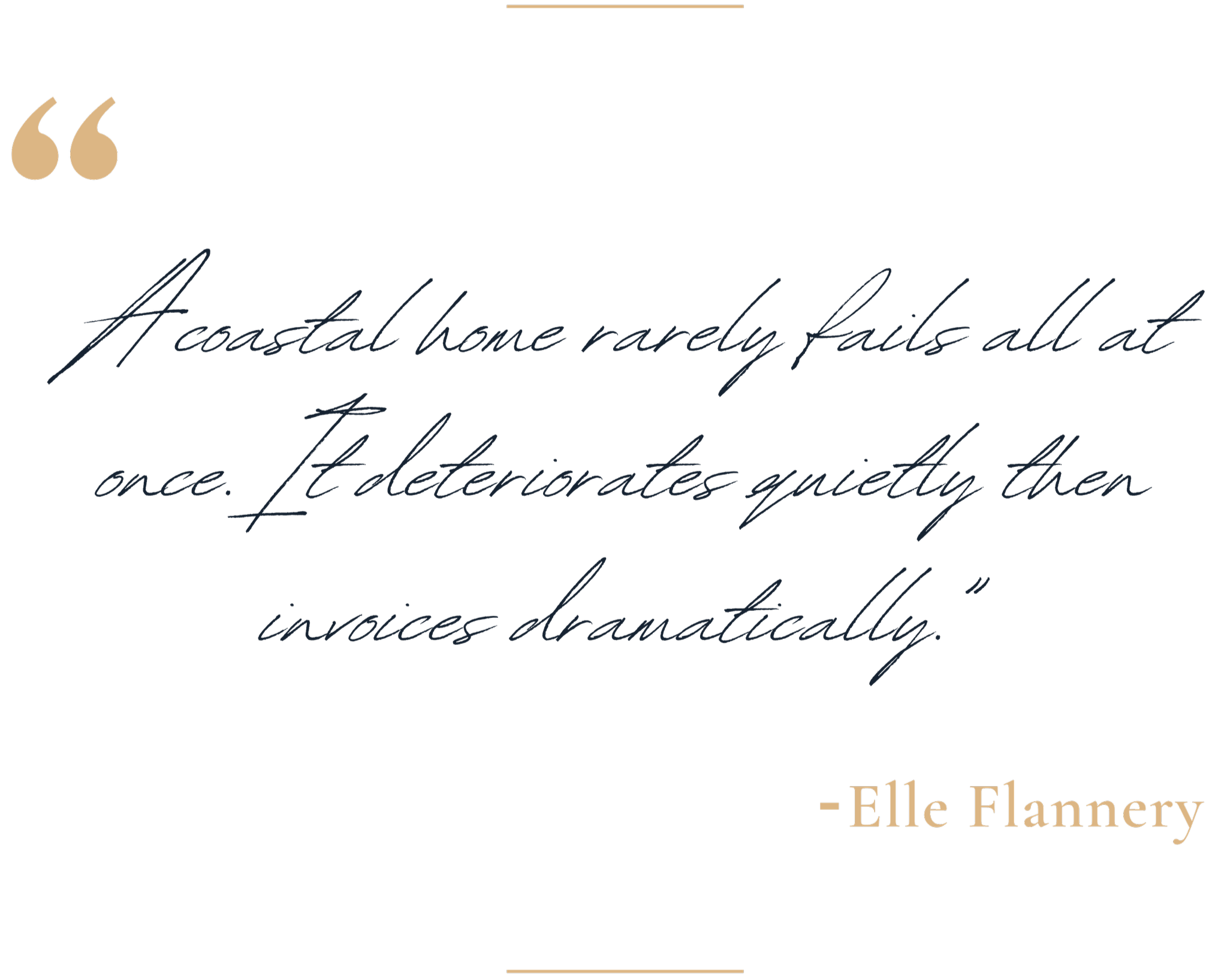
A coastal residence will always require care. The real decision is whether that care will be planned, documented and professionally overseen or delivered in a series of increasingly urgent phone calls. Reactive care waits for the home to demand attention. Professional estate management pays attention first.
The Estate Journal
Continue Reading
NEXT IN THE ESTATE JOURNAL

PREVIOUS IN THE ESTATE JOURNAL


The most expensive problems are often the ones no one noticed early.
Coastal Peace of Mind provides proactive oversight for exceptional coastal residences, tracking preventative maintenance, identifying subtle changes and addressing concerns before they become disruptive, costly or difficult to reverse.